
Shigeru Ban’s architectural work embodies a continuous quest to harness the structural capabilities of unconventional materials while addressing humanitarian and environmental challenges. His journey with paper tubes began in 1986 during an exhibition installation, where he discovered their potential as a cost-effective, easily replaceable, and eco-friendly structural option. These tubes can be crafted to various lengths, are recyclable, and generate minimal waste during production. Ban utilized this innovative material to create temporary shelters for earthquake survivors in Japan, Turkey, and India, as well as for over two million refugees in Rwanda. Remarkably, the structures built for the Rwandan refugees (from 1995 to 1999) ingeniously incorporated standard plastic sheets provided by the United Nations to form walls and roofs. To streamline the shelter-building process and mitigate local deforestation, Ban collaborated with a paper manufacturer to produce the tubes on-site, eliminating the need for transporting materials.
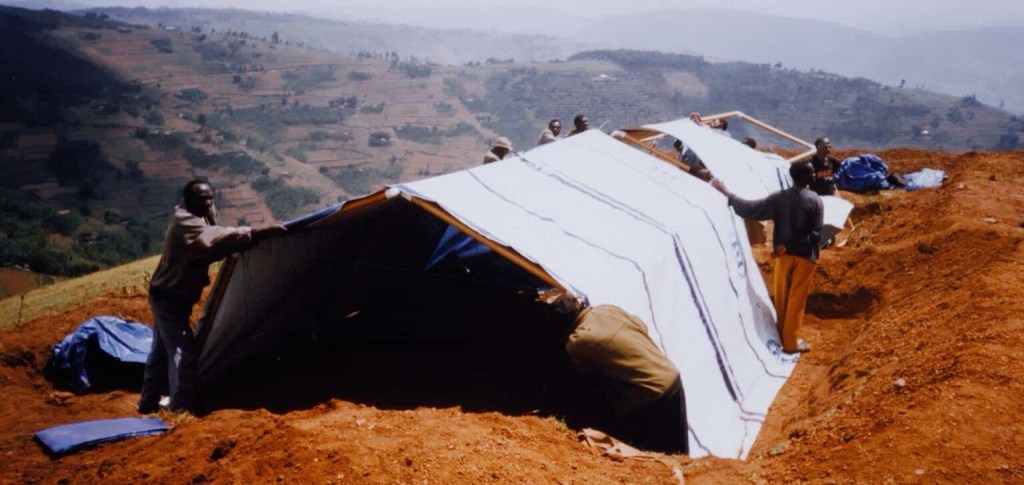
Rwanda, 1995-99
In a creative twist on traditional architecture, Ban played with the concept of a glass curtain wall in his Curtain Wall House in Tokyo (1993-1995) by using fabric as the primary material for the exterior. This innovative design features a massive two-story fabric curtain that, when closed, offers protection from the elements and a cozy sense of privacy, complemented by a series of sliding glass doors. Similarly, in the Naked House (1999-2000) in Saitama, Japan, he utilized a translucent layer of corrugated fiberglass-reinforced plastic to create a structure reminiscent of the region’s greenhouses, fostering an open-plan interior that encourages communal living for three generations of the client’s family.


Ban’s inventive use of materials extends to his institutional projects as well. In response to the theme of sustainable development at Expo 2000, he crafted a framework of recycled paper tubes for the Japan Pavilion in Hannover, Germany (1997-2000), enveloped in fiberglass-reinforced paper. For the Centre Pompidou’s satellite facility in Metz, France (2003-2008), he designed a striking woven roof composed of hexagonal wooden units, made waterproof with fiberglass and Teflon, that appears to float above the exhibition areas. He also worked on the project from an arched-roof temporary office made of paper tubes, covered with a waterproof membrane, located on an exterior terrace at the Centre Pompidou in Paris.

photo courtesy of Didier Boy de la Tour
More pictures of each project is available on out Instagram account
 Fashionecture